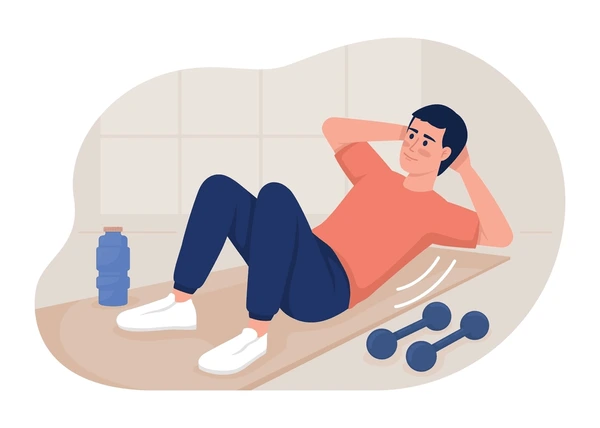
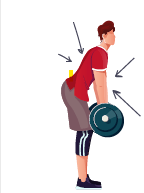
Core muscles form a muscular corset around the spine and pelvis, supporting them in an anatomically correct position. The stronger the core muscles, the healthier the spine and the better the posture.
By strengthening the core muscles, you can get rid of back pain, prevent the development of osteochondrosis and limit the risk for injuries, such as muscle strain or spasms in the lower back that, are very common to individuals like seafarers whose work often involves repetitive actions, heavy lifting and working in challenging conditions.
BENEFITS OF A STRONG CORE
Stabilising the lower back
Helping with balance
Supporting better posture
Supporting better exercise form
Increasing stability
Making everyday movement easier
Helping to reduce or prevent pain
Supporting strength training exercises
Helping to reduce lower body injury
YOU KNOW YOUR CORE IS WEAK WHEN:
Your back hurts
You have poor balance
You slouch all the time
Your feet and wrists hurt
You’re always holding your breath
HERE ARE A FEW EXERCISES YOU CAN DO WHILE ON BOARD TO IMPROVE YOUR CORE STRENGHT:
ABDOMINAL CRUNCH
Lie on your back and place your feet on a wall so that your knees and hips are bent at 90-degree angles. Tighten the abdominal muscles.
Raise your head and shoulders off the floor. To avoid straining your neck, cross your arms on your chest rather than locking them behind your head. Hold for three deep breaths.
Return to the start position and repeat.
SINGLE-LEG ABDOMINAL PRESS
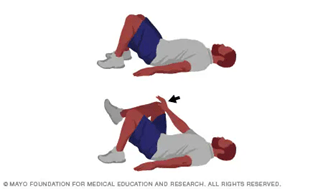
Lie on your back with your knees bent (top right illustration). Keep your back in a neutral position, not arched and not pressed into the floor. Avoid tilting your hips. Tighten the abdominal muscles.
Raise your right leg off the floor so that your knee and hip are bent at 90-degree angles. Rest your right hand on top of your right knee (bottom right illustration).
Push your hand against your knee while using the abdominal muscles to push your knee toward your hand. Keep your arm straight. Hold for three deep breaths.
Return to the start position and repeat using your left hand and left knee.
SINGLE-LEG ABDOMINAL PRESS VARIATIONS
Opposite hand on opposite knee. Push your right hand against your left knee while pulling your knee toward your
hand (top left illustration). You’ll be pushing and pulling across the centre of your body. Hold for three deep breaths. Then do the exercise using your other hand and leg.
Hand on the outside of the knee. Place your left hand along
he side of your left knee (bottom left illustration). Use your hand to push your leg inward. At the same time, create resistance by pushing your knee away from the centre. Hold for three deep breaths. Then do the exercise using your other hand and leg.
DOUBLE-LEG ABDOMINAL PRESS When you’re comfortable with the single-leg abdominal press, try the double-leg abdominal press for more core strength:
Lie on your back with your knees bent (top right illustration). Keep your back in a neutral position, not arched and not pressed into the floor. Avoid tilting your hips. Tighten the abdominal muscles.
Raise your legs off the floor, one at a time, so that your knees and hips are bent at 90-degree angles. Rest your hands on top of your knees (bottom right illustration).
Push your hands against your knees while using the abdominal muscles to pull your knees toward your hands. Keep your arms straight. Hold for three deep breaths.
Ratamess N. Resistance training exercises. In: ACSM’s Foundations of Strength Training and Conditioning. 2nd ed. Kindle edition. Wolters Kluwer; 2022. Accessed June 16, 2023.
Laskowski ER (expert opinion). Mayo Clinic. June 30, 2023.
Fernandez-Rodriguez R, et al. Best exercise options for reducing pain and disability in adults with chronic low back pain: Pilates, strength, core-based and mind-body. A network meta-analysis. The Journal of Orthopaedic & Sports Physical Therapy. 2022; doi:10.2519/jospt.2022.10671.
AskMayoExpert. Physical activity. Mayo Clinic; 2022.
Harvard Health Publishing, The real-world benefits of strengthening your core (2012)